AI model traceability, or how Telecom SudParis research is securing the future of digital technology
On November 19 2026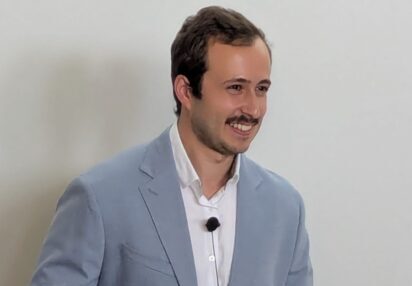
How can we verify the origin and integrity of an artificial intelligence model? In this era of massive AI roll-out, identification and traceability of neural networks have become a critical challenge for sovereignty and intellectual property. The fruit of the SAMOVAR Laboratory and ARTEMIS Department at Telecom SudParis, the IZENA Project (ex-TatouAI) headed by Carl De Sousa Trias is the winner of the Grand Prix i-PhD 2026 and is adapting digital tattoo techniques to AI models. A major scientific breakthrough illustrating the School’s leading role in Deeptech technology transfer.
In brief:
- Problem: The lack of traceability for AI models heightens the risk of theft, falsification, and non-compliance.
- Solution: IZENA applies the digital tattoo (watermarking) to neural networks to create a unique patented passport.
- Award: The project has been awarded the Grand Prix i-PhD 2026 in the “Innovations for New Societal Challenges” category (France 2030 / Bpifrance).
- Next step: The creation of a start-up and roll-out in the defense, healthcare, and aeronautical sectors.
A digital passport for AI model traceability
As we see AI models multiplying and evolving at breakneck speed, a crucial technical question remains unanswered: how can we verify the origin, integrity and history of a neural network that has been copied or modified?
This is precisely the complex scientific issue that Carl De Sousa Trias resolved during his thesis with the SAMOVAR Laboratory and ARTEMIS Department at Telecom SudParis, under the co-direction of Mihai Mitrea (Telecom SudParis) alongside researchers Marco Cagnazzo and Attilio Fiandrotti (Telecom Paris).
“The aim was to provide the world of artificial intelligence and neural networks with tracking tools, such as watermarking or a digital tattoo, for image or audio content”, Carl De Sousa Trias explains.
By incorporating a robust identification mark at the algorithms’ core, this technology enables the creation of a genuine ID card for AI models. It meets three priority industrial and societal needs:
- Authentication & Intellectual Property: Identify models and detect any unauthorized reuse or derivation
- Audit & Integrity: Accurately quantify alterations the model has undergone to prevent potential attacks or alterations
- Compliance & Governance: Provide comprehensive traceability on the origin of models in highly-regulated sectors
From thesis to patent, research excellence applied to the market
IZENA’s path demonstrates the relevance of the research approach at Telecom SudParis, focused on overcoming concrete technological barriers. At the end of his thesis, given the outstanding results of his most recent traceability method, the team made the strategic choice to protect the fruit of Carl’s labor with a patent rather than a simple scientific publication.
This innovation is thus officialized via a patent filing: C. De Sousa Trias, M. Mitrea, E. Tartaglione, S. Chaudhuri, “Procédé pour protéger par traçage un réseau artificiel de neurones [Procedure to protect an artificial neural network via tracking]”, French patent request FR2505074 (May 2025).
This bridge between fundamental research and technological transfer is at the core of the Telecom SudParis model.
“This State Innovation Competition award illustrates Telecom SudParis’ ability to produce ground-breaking technologies from research and guide them right to their entrepreneurial realization”, says François Dellacherie, Director of Telecom SudParis.
The academic environment and project-based training, particularly the Advanced Path in High-Tech Imaging (HTI) led by the ARTEMIS Department at Telecom SudParis and taken by the engineer, enabled him to consolidate his skills in concrete research issues.
A tailored support ecosystem for Deeptech
Granted in 2024, the Institut Polytechnique de Paris Newton pre-maturation program (then Newton-UP in 2025) allowed the researcher to launch a post-doctorate phase, again with the ARTEMIS Department at Telecom SudParis, devoted to market exploration and product design.
With this Grand Prix i-PhD 2026 award (operated by Bpifrance as part of France 2030), the project now avails of a unique form of support synergy:
- Intellectual Property and structuring: Guidance by the commercialization teams at Telecom SudParis and the IMT Starter incubator.
- Business Design & UX/UI: Support in methodology from the IP Paris innovation unit.
- Business maturation: A national program to transform excellence research into a lasting commercial offer.
The next step: industrial roll-out and strategic application
Now named IZENA, which means “identity” in Basque, the future start-up is entering an industrial validation phase. The team is focusing its efforts on developing a Proof of Concept (PoC) and an MVP targeting three key strategic sectors: defense, healthcare, and aeronautics.
By placing its teacher-researchers and young doctors at the forefront of digital trust and AI cybersecurity, Telecom SudParis affirms its status as an essential research partner for industrial players in the Deeptech sector.
Useful Resources
-
- Explore the work of the SAMOVAR Laboratory (Télécom SudParis / IP Paris)
- Learn more about the teaching and research activities of the ARTEMIS Department at Télécom SudParis
- Learn more about our research and technology transfer activities
- Download the official press release
- Learn more about the government innovation competitions - Bpifrance