AI and Contradictory Data: Telecom SudParis Wins an Award at the IJCAI 2026 World Conference
On October 13 2026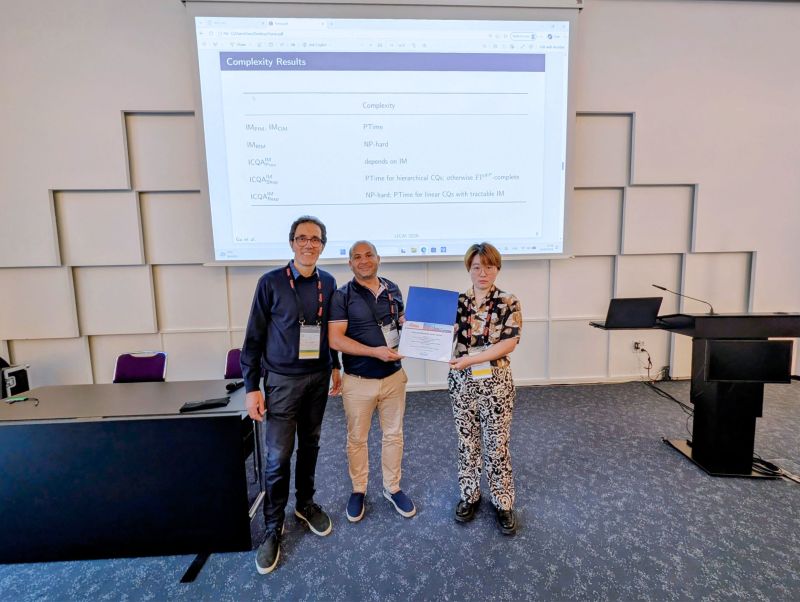
For only the fifth time since 1969, a French team has won a Distinguished Paper Award at IJCAI, the premier international conference on artificial intelligence. Awarded to Badran Raddaoui and his co-authors from Telecom SudParis, this distinction recognizes a major breakthrough: enabling AI systems to reason more reliably and transparently when confronted with real-world data, which is often imperfect or contradictory.
A Major Milestone for French Artificial Intelligence Research
At the 2026 edition of the International Joint Conference on Artificial Intelligence (IJCAI), the research conducted by Badran Raddaoui, Associate Professor at the SAMOVAR Laboratory at Telecom SudParis (Institut Polytechnique de Paris), won the prestigious Distinguished Paper Award*.
Co-authored by Yurun Gu (PhD student at Telecom SudParis), Yue Ma and Nicole Bidoit (Université Paris-Saclay / LISN) as well as Katerina Tzompanaki (CY Cergy Paris Université / BETIS), this publication, entitled “Tuple Inconsistency Measures: Towards Explaining Query Answers,” addresses a major challenge: how can AI be enabled to produce reliable and explainable decisions when the data it relies on may contain errors or contradictions?
The Industrial Challenge: Addressing the Massive Inconsistencies in Real-World Data
In most industrial and medical settings, real-world databases are rarely perfectly reliable. Data-entry errors, the integration of heterogeneous sources, faulty sensors, and outdated information can all lead to frequent violations of integrity constraints and the generation of contradictions.
Most traditional data management methods are still based on a strong assumption: data must be consistent to enable reliable reasoning. When a contradiction occurs, the system may then be forced to ignore certain information, interrupt its processing, or produce a potentially erroneous response.
“In practice, cleaning or correcting an entire database is often unfeasible due to the extremely high cost. Our approach enables robust reasoning in the presence of inconsistencies, without having to eliminate all contradictory data beforehand,” explains Badran Raddaoui.
The Innovation: Combining Symbolic AI, Inconsistency Measurement, and Explainability
The breakthrough achieved by the Researchers at Telecom SudParis is based on the development of a new family of tuple inconsistency measures.
At the intersection of symbolic AI, formal logic, and causality theory, the team has developed , a provenance-based inconsistency measure. This method assesses the exact contribution of each individual data item to constraint violations:
- Precise quantification of conflicts: quantifying the degree of responsibility of a data item in inconsistencies as well as the frequency of its involvement in them.
- Extension to query answers (ICQA): propagating the inconsistency measure through to the final result provided to the user.
- Enhanced explainability: the system can certify a response or precisely explain the extent to which it is affected by a contradiction, while identifying the source data that contribute to it.
Practical applications: From Healthcare to Aviation Safety
Supported by the French National Research Agency (ANR – EXPIDA project), this research offers concrete prospects for technology transfer.
- Healthcare and patient records: for the cross-referencing of medical test results, clinical observations, and conflicting medication histories, the method identifies areas of contradiction and helps practitioners make informed decisions based on imperfect data.
- Aviation safety and risk management: the analysis of incident reports from multiple and sometimes conflicting sources enables problems to be traced back to root causes without hindering the overall analysis of the chain of events.
- Data governance and the AI Act: the approach provides decision-making traceability essential to the transparency requirements of European AI regulations (AI Act).
Strong Foundations in Engineering Education
Beyond its scientific and industrial significance, this award highlights the excellence of the research conducted at Telecom SudParis and its direct impact on education. Yurun Gu, lead co-author of the paper, is pursuing her PhD at our school and helping to train the next generation of experts in robust AI.
With this major contribution to the global state of the art in explainable and robust AI, Telecom SudParis has reaffirmed its role as a trusted partner in helping businesses manage and leverage their complex data.
Scientific References & Information
- Award-winning paper: Tuple Inconsistency Measures: Towards Explaining Query Answers, Proceedings of IJCAI 2026.
- Authors: Yurun Gu (Telecom SudParis), Badran Raddaoui (Telecom SudParis), Yue Ma (Université Paris-Saclay), Aikaterini Tzompanaki (CY Cergy Paris Université), Nicole Bidoit (Université Paris-Saclay).
- Institutional framework: SAMOVAR Laboratory, Institut Polytechnique de Paris, ANR EXPIDA Project.
Learn more about Research and Technology Transfer at Telecom SudParis
Interested in Innovating With Our Research Teams?
Whether you are an innovation manager, a company, or an institution, our faculty members can assist you with the development of customized AI solutions. Contact the Innovation and Corporate Relations Department. olivier.martinot@telecom-sudparis.eu