Network protocol security: Telecom SudParis puts IoT state machines to the test
On November 19 2026
Listed as number CVE-2025-14942 and with a critical severity score of 9.4/10 (CVSS), a major vulnerability identified in the wolfSSH client demonstrates the limitations of standard code audits. This vulnerability was discovered by Olivier Levillain, a researcher at Telecom SudParis, and Aina Rasoamanana (Valeo), and illustrates the maturity of Active Automata Learning, a pioneering methodology developed by the engineering school to map critical embedded and industrial systems and secure them within a black box.
In brief:
- Discovery: Identification of a critical authentication bypass in wolfSSH (versions prior to 1.4.22), a widely-used software brick in embedded and IoT equipment.
- Ground-breaking methodology: Use of Active Automata Learning (state machine inference), a black-box approach capable of detecting logic errors without access to the source code.
- Industrial value: A transfer method enabling R&D teams to test the robustness of their protocol stacks (SSH, TLS, QUIC, RDP, OPC UA).
SSH and embedded systems, blind trust called into question
In modern digital architecture, the SSH (Secure Shell) protocol forms the backbone of remote administration. Its premise is based on a strict sequential chain of three layers:
- The Transport layer (setting-up of the secure channel and server authentication)
- The User Authentication layer (verification of the customer’s identity)
- The Connection layer (opening of applicative data channels)
“While the TLS protocol has been analyzed from every angle by the scientific community, SSH has drawn less attention, despite being crucial to the administration of our infrastructures”, says Olivier Levillain, associate professor of information systems security at Telecom SudParis and former laboratory head at ANSSI.
The test carried out on wolfSSH, a lightweight implementation favored by the automobile, aeronautical and connected object sectors, revealed a major structural anomaly; the software’s state machine was prematurely accepting messages from the user authentication phase before the server had proved its identity.
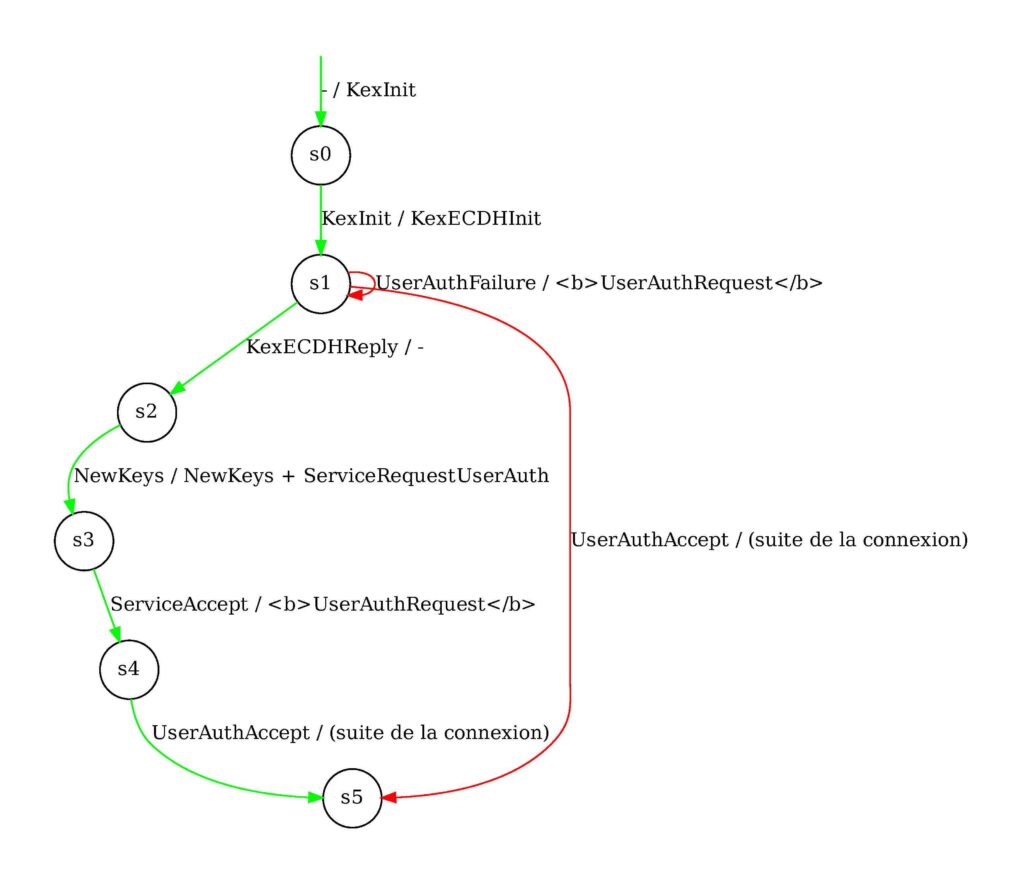
For an attacker acting as a man-in-the-middle, this vulnerability paves the way for two critical scenarios:
- Identity leaks: sending a message too soon misleads the customer, prompting them to transmit their password in plain text.
- Session hijacking: sending a fake valid authentication signal allows an attacker to bypass server authentication and eavesdrop on the entire data stream.
Active Automata Learning, the power of “black-box” analysis
The strength of this discovery lies not just in the identification of the bug, but also in the method used. Under development since 2019 by the Digital Security and Trust team (SCN) within the SAMOVAR Laboratory (Telecom SudParis), the approach is based on Active Automata Learning (or state machine inference).
In practical terms, the tool interacts with the executed software without ever consulting its source code. Via an automated dialog based on the L* (LSTAR) algorithm, it submits message sequences and analyzes the responses to reconstruct the application’s internal state machine based on the behavior it observes.
A key component, the Mapper, translates algorithmic abstractions into real network messages. “This translation poses the greatest technical challenge. The learning algorithm is unaware of the protocol’s limitations and sometimes calls on seemingly absurd sequences. We reveal the hidden vulnerabilities by exploring these unexpected sequences specifically”, Olivier Levillain explains.
This approach outperforms standard audits thanks to its ability to overcome code fragmentation; where thousands of C or C++ lines conceal the global logic of a protocol, inference offers a verifiable, visual modeling of real components.
A direct industrial impact and responsible disclosure approach
Software publisher wolfSSL was notified of the vulnerability as soon as it was confirmed via a Responsible Disclosure procedure, and set to work quickly with the teams at Telecom SudParis to validate the patches. The wolfSSH v1.4.22 secure version, published in January 2026, incorporates the patch validated by the researchers
This incident provides three lessons for industrial R&D and embedded software publishers:
- Simplify specifications: reduce the unnecessary complexity of protocols to minimize uncontrolled states.
- Formalize the state logic: design state machines explicitly and rigorously on the software architecture level.
- Automate negative tests: incorporate robustness tests into test benches that deliberately inject out-of-sequence messages.
A key player in R&D research on cybersecurity
Based on the thesis by Aina Rasoamanana defended at Institut Polytechnique de Paris, this publication illustrates the applied, partner-based research model advocated at Telecom SudParis, as Aina is now an R&D engineer at Valeo.
The School is currently extending this inference framework to other critical protocols for industry, such as QUIC, RDP (Remote Desktop Protocol) or OPC UA in the industrial network field.
FAQ
Q: What is the CVE-2025-14942 vulnerability?
A: This is a vulnerability in the wolfSSH state machine (versions < 1.4.22) which allows an attacker in a man-in-the-middle position to bypass server authentication and obtain the user’s credentials or hijack the session.
Q: What is Active Automata Learning applied to cybersecurity?
A: This a black-box analysis method that interacts with a software implementation to reconstruct its internal state machine. It enables automatic identification of logic vulnerabilities without having to access the source code.
Q: Which industrial sectors are most exposed to this vulnerability?
A: The embedded systems, automobile, aeronautical and IoT sectors, who use wolfSSH for automated communication.
Useful Resources
- Explore the work of the SAMOVAR Laboratory (Télécom SudParis / IP Paris)
- Read the article by Aina Rasoamanana and Olivier Levillain in the special section of the revue MISC (n°147, septembre-octobre 2026)
- Learn more about our research and technology transfer activities